Oct 24, 2014

Witness at Lebanon Tribunal describes the assassination: "And I saw hell"

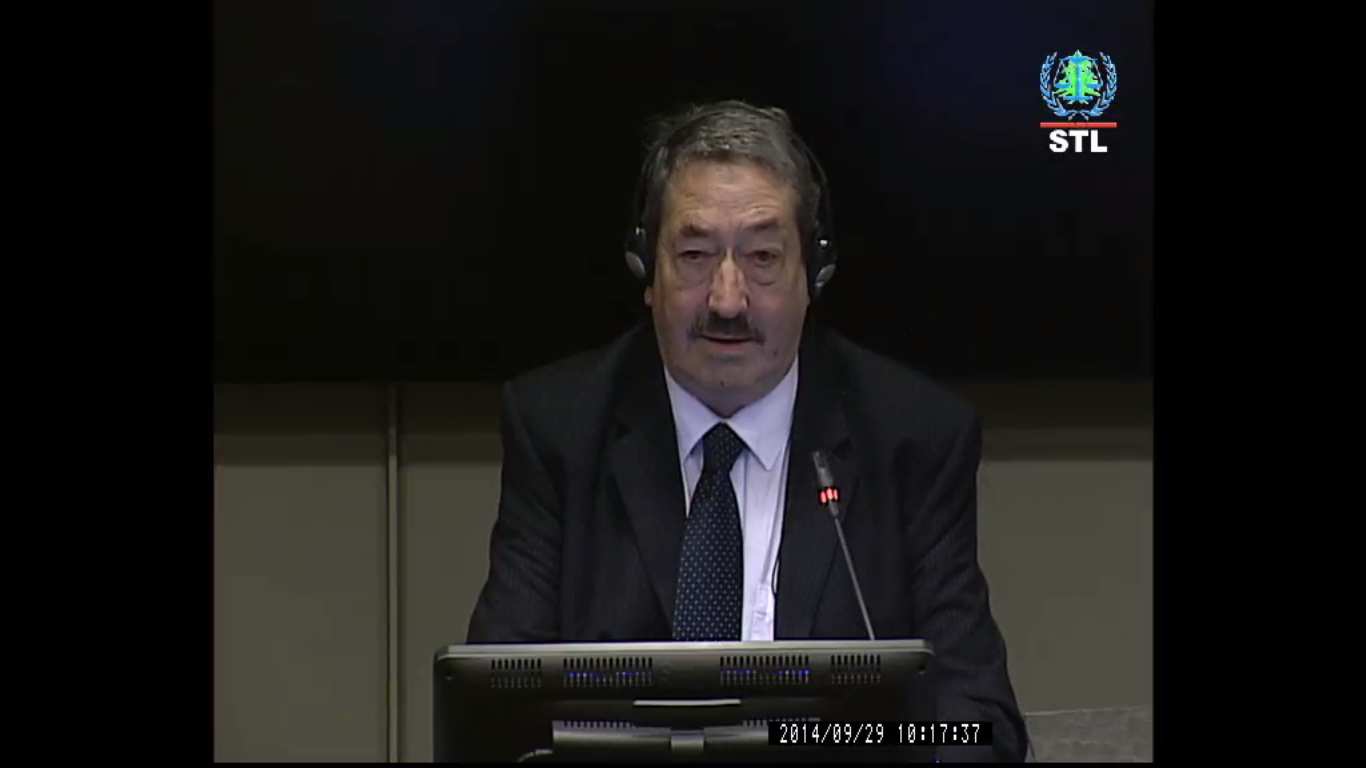
On 16 October the next Prosecution witness was also a surviver from the convoy of Mr. Hariri that was attacked on 14 February 2005 and killed former Lebanese Prime Minister Mr. Rafik Hariri and 21 others.  Like the previous testimony, Mr. Amer Chehadeh was a security guard for Mr. Hariri and had been working for the Hariri family since 1985. When Mr. Hariri became Prime Minister the witness became a close protection officer for him until the time of his assassination. This witness also traveled with Mr. Hariri throughout Lebanon and abroad.

On the day of the assassination, there was only one car of the Internal Security Forces (ISF) in Mr. Hariri's convoy, that was the lead vehicle. When Mr. Hariri was still Prime Minister, he had much more security than afterwards. At the time of the assassination, there were only some 35 to 40 ISF members assigned to his protection, whilst during his premiership there were some 400 protecting him.


[Screenshot of Mr. Amer Chehadeh.]

Normally, Mr. Chehadeh did not drive in the convoy, but would only do so when the team was not complete.

In the weeks leading up to the bomb attack, Mr. Abou-Tareq, the head of security, had given instructions to the security personnel to remain alert, though he testifies that they never felt any danger or threat; they never expected what happened, they never thought of that. They sometimes used a decoy technique, where they would create a second convoy, sent to act as a decoy.

In each car of the convoy, it would be the person in charge of the car who was responsible for the turning on and off of the jamming device (see yesterday's blog for Witness 76 on jamming devices). To check whether the device worked, they would turn the radio on: if the radio would no longer be operational, the device would work. Even television sets in the nearby areas would stop working when the jammers were turned on. They discuss one of Mr. Chehadeh's colleagues who was absent on 14 February 2005, the day of the assassination. That person will also be testifying in court under the pseudonym PRH247. This person still works for the Hariri family.

Mr. Chehadeh further testifies about that day, that he did not notice anything that caused him concern on that day and when reaching the St. Georges Hotel; he saw nothing out of the ordinary. This witness remembers the explosion itself, and he testifies:
"As far as I remember, I heard a loud noise and the vehicle flew. It was no longer on the ground and then it hit the ground very hard. I asked the person next to me: Are you okay? He said: Yes. I went out of the car and looked to my back and I saw hell. It was fire everywhere, smoke, and I understood that it was an explosion."
In cross-examination, the witness is asked about the vehicles of Mr. Hariri's convoy, and who would have access to them overnight. This would be virtually anyone within the residence; there were no locked doors but CCTV cameras.

Regarding the jammers, the witness testifies that they would normally check whether they were working immediately after switching them on; they would not check them again whilst driving.

The witness testifies about an ambulance that was at quite a close distance behind the convoy. In an earlier statement (a public document, but unfortunately not available on the Court's website) the witness had indicated that he had heard that the radio was on in the ambulance. Given that the effective range of the jammers was approximately hundred meters, and the ambulance was much closer to the convoy than that, the logical conclusion would be that something was wrong with the jammers.

When they arrived at the St. Georges Hotel on the particular day, the witness had not seen anything out of the ordinary; he did not see any truck or van parked outside the hotel. Double-parked vehicles were a very normal sight in Lebanon, but he saw nothing unusual. This witness finished his testimony within the day, and the subsequent witness, Mr. Dia, was sitting in the same convoy car as Mr. Chehadeh on the day of the assassination.

Oct 23, 2014

Witness 76: Survivor of the convoy

In the week of 14 to 17 October 2014, the Special Tribunal for Lebanon saw three Prosecution witnesses testify about their experiences as victims of the attack on former Prime Minister Rafik Hariri's convoy on 14 February 2005.

The first witness testified on 14 and 15 October under protective measures and is indicated by the pseudonym PRH076, or in short "Witness 76". His identity and voice were obscured during his testimony in court.


[Screenshot of witness PRH076 testifying with protective measures.]

Witness 76 had been employed by Mr. Hariri since 1995 and from 2000 onwards had been his close protection officer.

In his testimony, Witness 76 explains the protection of Rafik Hariri, who at the time that he was Prime Minister was usually guarded by his personal body guards as well as officers from the Internal Security Forces (ISF). He normally drove an armoured car that provided protection against light bombs and bullets. The other cars in such convoy were not armoured. The witness testifies that the cars in the convoy were fitted with jammers, except for Mr. Hariri's vehicle. These devices would jam any remotely detonated explosives. Also on the 14th of February 2005, these jammers had been turned on. When the explosion occurred, the witness had lost his consciousness and when he awoke he was in the hospital; an hour after the explosion he realised that Mr. Hariri had been assassinated.

The witness testifies about meetings Mr. Hariri had had with Syrian President Bashar Al-Assad in Syria. He mentions one particular trip to Syria, when Mr. Hariri met the Syrian President. Mr Hariri returned from that meeting and he was very upset. According to the witness, they had discussed the extension of Mr. Hariri's presidential term; this was between 2004 and 2005. The witness describes that the bodyguards were warned about the threat posed by Hezbollah. Prior to the assassination, there had been an unspecified security threat that they had been informed of.

Witness 76 describes the details of the convoy on the day of the assassination up until the explosion took place. The witness also testifies about a threat he received some two years after the assassination, when he received a phone call and a person told him that "[i]f you do not change what you said to the Tribunal, you are going to follow your colleagues who died before you". The witness, however, does not seem too concerned about it when he tells the court that "if someone really wanted to hurt me, they would have done so after the first phone call that I've received".  The witness informs the court that all information relating to his testimony had been broadcast by some Lebanese television stations, and that all that information had been accessible to the public.

On the second day of his testimony in court, Witness 76 was cross-examined by defence counsel Mr. Edwards, representing the interests of defendant Badreddine. He confronted Witness 76 with evidence that not all the jammers in all the cars functioned properly on the day in question. A witness testifying in court next week would make such declaration in court, therewith undermining this witness's statement that all the jammers were functioning properly. The witness was also confronted with Mr. Wissam Al-Hasan, Mr. Hariri's chief of protocol who was absent at the day of the assassination, which arouse suspicion at a later stage, and this obviously forms an interesting theory for defence counsel representing the interests of the five absent accused. 

Oct 18, 2014

Another survivor from Mr. Hariri's convoy: Mr. Dia

The subsequent witness on 16 and 17 October was Mr. Mohammed Jamal Dia, another survivor from Mr. Hariri's convoy that was attacked on 14 February 2005, and he was sitting in the same car as the previous witness, Mr. Chehadeh (see here for our blog post on his testimony). The witness was the person in charge in that particular car at that day and he was specifically assigned to be on the lookout. He states he saw nothing out of the ordinary on that day.

Mr. Dia was a close protection officer for Mr. Hariri, having worked for the Hariri family since 1984. He would travel abroad with Mr. Hariri when required to do so. The witness describes the motorcade of Mr. Hariri, including the ISF (Internal Security Forces) jeep in front, the Mercedes that Mr. Hariri drove in, the ambulance at the back of the convoy and several other cars. This witness is also questioned about the jamming devices. When he was Prime Minister, the convoy had been much more extensive than afterwards. Also, when he was still Prime Minister, usually ahead of the convoy there would be an ISF reconnaissance drive to explore the area; this no longer happened when Mr. Hariri was no longer Prime Minister.

Regarding the jammers, the witness recalls on the 14th of February 2005, the day of the explosion, that the son of Mr. Hariri had tried to call him, but had failed to reach him due to the active jamming devices. This evidence is based on hearsay, the witness heard this four or five hours later, when he was at Quraitem Palace. 

On the second day of his testimony, the witness is asked about his (unnamed) colleague who was unexpectedly absent from work on 14 February 2005, due to migraine, from which he sometimes suffered. That day, Mr. Dia was sitting in the car next to the previous witness, Mr. Chehadeh, who was driving the vehicle. After the explosion, Mr. Dia lost his consciousness for a few minutes. After he regained his consciousness, he stepped out of the car. He saw a person lying on the ground, and he was able to identify that person as Mr. Hariri; he could identify him by his wedding ring, and he does not remember seeing his face, and it was clear that he had passed away. 

After the incident, the witness stayed at home for three months to rest. He is cross-examined by defence counsel Mr. Edwards for defendant Mr. Badreddine. Mr. Edwards asks the witness whether there was a debriefing after the attack. The witness denies this, but seems to have suggested something different in an earlier statement Mr. Dia made to the UNIIIC (UN commission investigating the assassination prior to the existence of the STL). In his earlier statement to the UNIIIC, the witness had mentioned authorization documents issued by Rustom Ghazaleh, the head of the Syrian security in Lebanon. When confronted with that information, the witness no longer recalls this information. 

The witness is then shown a security document, a laissez-passer, issued by Syria to Lebanese security personnel, belonging to (protected) witness PRH247. The witness confirms that such documents are very common in Lebanon. About the value of such cards, he states that they have no value, but some people like to have them, others don't.  The witness does not recall ever having been offered such a document, and he never obtained one. 

Oct 16, 2014

Some further thoughts on the STL Appeals Chamber decision on criminal liability for legal entities

In a ruling entitled ‘Decision on Interlocutory Appeal Concerning Personal Jurisdiction in Contempt Proceedings’ (‘Decision’), the Appeals Chamber of the Special Tribunal for Lebanon ruled that the defendant NEW TV S.A.L., a Lebanese media corporation, can be prosecuted for contempt of court in relation to the publication of names of persons alleged to be witnesses. Together with the media corporation’s Deputy Head of News and Political Programmes Manager, Ms. Karma Al Khayat, NEW TV S.A.L. is charged with knowing and willful interference with the administration of justice. In an earlier blog, we discussed the merits of this case.

In a guest blog on the International Justice Monitor website, we concluded that the legal analysis underlying this decision is quite unconvincing, however, the outcome is groundbreaking in that it lays the ground for criminal responsibility for corporate entities under international law. Never before has an international criminal tribunal held that it could prosecute non-natural persons. This blog post does not attempt to provide a detailed analysis of the Decision, but rather mentions a few aspects thereof that are food for discussion. 

According to Rule 60bis of the Tribunal’s Rules of Procedure and Evidence any person can be held in contempt of court if they, inter alia, “disclose[] information relating to proceedings in knowing violation of an order of a Judge or Chamber”. The question is thus whether “person” includes legal persons, or only refers to natural persons. There are various methods of interpretation of legal clauses, and normally, one first looks at the actual text of the provision to find its ordinary meaning. In looking at all three official languages of the Tribunal—English, Arabic and French—the Appeals Chamber concludes in paragraph 36 that “the ordinary definition of the term ‘person’ in a legal context can include a natural human being or a legal entity (such as a corporation) that is recognized by law as the subject of rights and duties”. It may have been preferable for the Chamber to stop its legal reasoning after arriving at that conclusion. The Decision then goes on to attempt to find a basis in international law for the conclusion that legal persons can be held criminally liable, but from then on, the logic of argumentation in the Decision decreases.

The Decision notes that “there is an emerging shared international understanding on the need to address corporate responsibility” (para. 46). It firstly notes in that respect that international human rights standards and the positive obligations arising therein are equally applicable to legal entities. The legal basis the Decision provides for this important conclusion is, to put it mildly, very thin.
It first cites General Comment 31 of the UN Human Rights Committee, Nature of the General Legal Obligation Imposed on States Parties to the Covenant, UN Doc. CCPR/C/21/Rev. lIAdd.13, 29 March 2004, para. 8:

“the positive obligations on States Parties to ensure Covenant rights will only be fully discharged if individuals are protected by the State, not just against violations of Covenant rights by its agents, but also against acts committed by private persons or entities that would impair the enjoyment of Covenant rights in so far as they are amenable to application between private persons or entities".

First, a “General Comment” is not binding international law. Second, the wording of the General Comment does not suggest that international human rights standards are binding on legal entities, it merely indicates that States Parties can only discharge of their duties if individuals are protected against legal entities. The second source cited in this respect is the Maastricht Principles on Extraterritorial Obligations of States in the area of Economic, Social and Cultural Rights. First, as the title suggests, these are mere ‘principles’, and again not binding international law. Secondly, Principle 25 is quoted, which states that "[a]ll States must take necessary measures to ensure that non-State actors which they are in a position to regulate, as set out in Principle 25, such as private individuals and organisations, and transnational corporations and other business enterprises, do not nullify or impair the enjoyment of economic, social and cultural rights". It merely says that states must take action, no more than that.

The Decision continues to argue that a report by the Human Rights Committee on the issue of human rights and transnational corporations and other business enterprises and “Guiding Principles on Business and Human Rights: Implementing the United Nations ‘Protect, Respect and Remedy’ Framework” represent a “concrete movement on an international level backed by the United Nations for, inter alia, corporate accountability” (para. 46), which really means not much in a legal context.

In the subsequent sentence, the Chamber indeed acknowledges the non-binding nature of the sources cited. It seems to conclude nonetheless that criminal prosecutions are possible, in an impossibly formulated sentence:
“Although we are wary that such instruments are non-binding, in light of the fact that corporations have been considered subjects of international law, the possibility of proceeding against a corporation through criminal prosecution cannot discarded but rather criminal regimes are regarded as an available remedy.” [footnote omitted]
It then comes to the convenient conclusion that “[t]he Appeals Chamber considers these factors to be evidence of an emerging international consensus regarding what is expected in business activity, where legal persons feature prominently, in relation to the respect of human rights”. It states there is an emerging international consensus, but then fails to formulate what this consensus is about.

Was the Chamber here merely lazy in only referring to non-binding principles and comments by UN bodies, or did it attempt to find stronger evidence for its far-stretching conclusion, but was it non-existent? The Chamber readily admits that there is no norm of customary international law that provides for criminal liability for corporations (see para. 50), it indicates that it does not have to be constrained by that fact (para. 59), given its inherent jurisdiction over contempt of court.

In conclusion, it can be said that the decision is indeed groundbreaking in that, for the first time in international criminal law, a tribunal has held that it can prosecute a legal person. However, whilst the development itself may be praiseworthy, the legal foundations of the Decision are questionable.

And whilst it may be praiseworthy to hold all actors that may be involved in human rights violations accountable, we have to be mindful that this conclusion, based on such weak arguments, violates the principle of in dubio pro reo, as indeed indicated by Judge Akoum in his Dissenting Opinion. The Chamber’s focus on holding corporations accountable for their behavior should not supersede the more important principle that no one should be prosecuted without a prior basis in law, and that any doubt as to the interpretation of such criminal provision should be explained in favour of the accused person, in this case the legal person. Paradoxically, the Chamber by attempting to secure the protection of human rights at large, failed to protect the human rights of one of its accused that it was supposed to protect. 

There are many more aspects of this Decision that deserve a closer analysis than the few thoughts discussed here, and we are eagerly awaiting discussion by other international lawyers and interested persons!


Oct 15, 2014

Testimony by Dr. Murray on the chemical analysis of explosives used in the attack


On 29 and 30 September, Dr. Gerard Murray came to the stand to testify about specific tests as part of the wider investigation in cooperation with Dr. Van der Craats, the forensic scientist from the Dutch Forensic Institute (NFI), who testified several weeks prior to Dr. Murray's testimony (see here).

[Screenshot of witness Dr. Gerard Murray]

Dr. Murray is a British specialist in analytical chemistry. He has dealt with many explosions during his 40-year long career in the UK, and was invited by the Dutch investigators' team to join their investigation. Together with Dr. Van der Craats, the witness examined which of the items recovered from the crime scene were suitable to examine for explosives residues. The analysis of the swabs taken by the witness was done in a laboratory in Northern Ireland. The witness visited the crime scene in order to observe the damage that had been caused. The witness was not involved in the actual collecting of the evidence, but only the examination thereof. 

The testing in the laboratory consisted of so-called high-pressure liquid chromatography, consisting of two series of tests, the first series is an attempt to identify if any materials of significance are present, the second series to confirm the presence or absence of such materials. The tests look for the most commonly experienced organic explosive materials in Northern Ireland (inorganic residues are so common in the general environment that there is no point in looking for them). 

The witness describes the traces of explosives they discovered at the crime scene items. On several of the swabs, witness found traces of the explosive RDX, a very powerful high explosive, and a component part of the plasticised explosive Semtex. It is not possible to tell whether the explosive Semtex was used, only that an RDX-based explosive was used. The witness also explains the possibility of the Prosecution's theory that a suicide bomber drove a Mitsubishi Canter van to the location to detonate the bomb there. The most likely scenario being that the Mitsubishi van contained an improvised explosive devise in the back of the vehicle. A less likely scenario would be that of a remotely controlled device. The witness informs the court that in his view it is relatively easy to acquire the components to make RDX. The witness believes the explosive used was obtained from Libya, but this is information he received through conversations with police officers and through the media.

In cross-examination, the witness is asked about possible cross-contamination of the explosive residue. He indeed indicates that such cross-examination can take place. He is specifically asked whether the residue found at the crime scene could have been the result of cross-contamination, but the witness was not present when the swabs with the residue were taken from the crime scene, so he states that "all I can say, Your Honour, is that RDX was detected on those swabs. I can't elaborate on how it got to be there." 

In cross-examination, counsel for Mr. Badreddine Mr. Edwards, asks the witness about precautions to protect the evidence, normally taken at a crime scene, obviously with regard to the lack of precautions taken at the crime scene in Beirut and the ensuing lack of credibility of the evidence coming from that crime site, e.g. the exhibits swabbed were only taken some seven months after the explosion. He recalls the items were laid out in the open in a hotel room in Beirut, and admits that items may have been cross-contaminated, which may be an important element for the defence.

Appeals Chamber of the STL decides it can prosecute legal persons for contempt

For our analysis of the 2 October 2014 Appeals Chamber decision on the jurisdiction over the media corporation, please see our guest blog on the website of the International Justice Monitor.


Witness PRH155: Spanish police inspector

Witness PRH155, testifying under that pseudonym, is a Spanish police inspector working on anti-terrorism cases. He has extensive experience in relation to investigating car bombs: his first voluntary posting was in the north of Spain, were the ETA terrorist movement was very active.

Witness PRH155 was in charge of the Spanish 9-member investigation team that went to Beirut in 2006, investigating the bombing of former Prime Minister Rafiq Hariri's motorcade; their final report is dated 14 July 2006. The witness and his team conducted a final investigation of the crime scene, though this was some fifteen months after the explosion had taken place. The witness concedes that it is not an ideal situation to investigate a crime scene some fifteen months after the crime. The site had already been manipulated and adjusted by previous investigation teams, but they specifically searched for areas that may have been overlooked or left out by previous investigators.

 The witness indicates that in spite of his extensive experience in Spain, he had never been confronted with an investigation like the one in Beirut, where there were so many items found. The Spanish investigation team found several biological and other items; nine thereof were identified as coming from the 'unknown man' (we blogged earlier about this 'unknown man', see here). One of the judges asked the witness how in his view it was possible that they still managed to find new pieces of evidence some fifteen months after the attack, after so many investigative teams had already examined the area, and the witness attempts to answer this by saying that perhaps immediately subsequent the attack people were not sufficiently calm to proceed with caution to examine a crime scene like that.

The witness further testified to certain shortcomings in the preservation of the crime scene, including the heavy machinery used, the piling up of rubble, and the fact that they were the last team on the scene after many others had already investigated the area.

In his testimony, this witness also testifies about the shortage of time given to do the investigation. He had attempted to convince the UN to give their team more time, but the UN explained that the time period was not negotiable.

We would like to thank our intern, Ms. Eleonore Kahn, for her analysis of witness PRH155's testimony for this blog post.