Apr 16, 2015

Start of the contempt case against Al Jadeed and Ms Karma Al Khayat: Opening statements

The first contempt case at the Special Tribunal for Lebanon started today. This is the case against Al Jadeed, a Lebanese media company, and its deputy head of news, Ms Karma Al Khayat. Al Jadeed and Ms Al Khayat have been indicted with two counts of contempt of court: (i) broadcasting and/or publishing information on purported confidential witnesses in the Ayyash et al. case, thereby undermining public confidence in the tribunal; and (ii) violating a court order to remove from its website and YouTube channel information on these purported confidential witnesses.

The Amicus Curiae Prosecutor, Mr Kenneth Scott, starts his opening statement by stressing the importance of free speech. He states that this trial doesn't pose a threat to free speech, as there are limitations to free speech and the media must comply with the law. The Prosecutor cites from a previous decision in this case that "freedom of the press must find its limits where it impinges upon the tribunal's ability to function properly as a criminal court". Mr Scott further takes the opportunity to counter the claims that have been made in the last few months that this case is unprecedented, pointing to the fact that most international courts have prosecuted journalists for contempt of court, and this often has resulted in convictions. Mr Scott thus stresses that this is not new territory, and that the case is important to protect the proceedings and the integrity of justice, as evidence by witnesses is essential for the functioning of the tribunal.


[Amicus Curiae Prosecutor Mr Kenneth Scott in court during today's hearing]

With these initial comments, the Prosecutor seems to attempt to address the concerns that have been raised in the media and by the Defence that the tribunal is trying to curtail the Lebanese media in its criticism of the tribunal, and that this case is unprecedented. It's the Prosecutor's view however that this case is about a media company that wanted a scoop, and would do anything to get that scoop. Al Jadeed thus broadcasted five series of a program called “The Witnesses of the International Tribunal”, and the entire tenor of the program was the exposure of alleged confidential witnesses. Al Jadeed included eleven persons as alleged confidential witnesses, with some of them even being unaware of the fact that they had been filmed; and although some of the faces were distorted, their voices were often included as well as other identifying information such as the person’s job or place of employment. Immediately after the broadcasting, persons that were shown in the program were called by family or friends.

The Prosecutor subsequently shows a selection of the program, without showing any parts that would reveal any alleged confidential witness information, as these parts are subject to protective measures and won’t be shown to the public. The Prosecutor further stresses that after the Registrar sent a notice to Al Jadeed demanding to cease and desist their program, Al Jadeed made a claim that the decisions of the tribunal are not legally binding for Lebanese media. Also, Al Jadeed did not comply with a court order to remove any confidential information or material allegedly relating to confidential witnesses, as the episodes of the program were put on the internet. Al Jadeed’s claim that the information they used was leaked from the tribunal, is according to the Prosecutor an unsupported assertion and part of its campaign to undermine the tribunal.

Mr Scott thus concludes that Al Jadeed’s documentary was intended to reveal confidential information, and that Al Jadeed's message to the public was that protected witness would be exposed. According to the Prosecutor this reduced the confidence of actual witnesses and the public in the tribunal, and directly interfered with the Tribunal's core function and the administration of justice.

The Defence then take the stance for its opening statement. According to Mr Karim Khan, lead counsel for Al Jadeed and Ms Karma Al Khayat, the Prosecution's case is without any merits. Mr Khan starts by  describing Al Jadeed as a young, independent, objective and courageous TV station, with ground-breaking broadcasts, and unpopular with those in power and authority. Mr Khan stresses that freedom of speech is a value to be protected, and that it is of core importance in any democratic society. Restrictions on freedom speech should be strictly necessary, proportionate and in accordance with the law. According to the Defence, contempt of court has never been prosecuted in this manner, as the Prosecution is not pleading a specific paragraph under Rule 60bis (A), but has built its case on the general claim of undermining confidence in the tribunal. The Prosecutor is thus not alleging that actual protected witness information has been revealed or that witnesses have been interfered with, only that the confidence in the tribunal has been undermined. According to the Defence this has no legal basis, and is new territory with the Prosecution making up its case as it goes along.

Mr Khan states that there was no criminal intent on the part of Al Jadeed or Ms Al Khayat. Al Jadeed has not revealed any names and the faces were pixelated. Al Jadeed only showed that names of witnesses were available in the public domain and that action should be taken against this. At no time did Al Jadeed broadcast any of the names of the witnesses and Al Jadeed and its employees have been fully cooperating with the tribunal. Employees of Al Jadeed sat down with the Amicus Curiae Prosecutor to answer questions, including the reporter of the program and Ms Al Khayat herself.

In relation to the order by the Registrar, Mr Khan explains that after receiving this order, Al Jadeed took legal advice from the Media Council of Lebanon, which confirmed that they could continue broadcasting the program. Further, the order from a judge was not properly served on Ms Al Khayat, and therefore she was unaware of this order. Mr Khan also briefly touches upon the alleged corporate responsibility of Al Jadeed, which according to the Defence is a violation of the principle of nullem crime sine lege, as there is no legal basis for this international law. In our guest blog on the International Justice Monitor, we have expressed similar doubts about the tribunal's jurisdiction to prosecute legal persons.
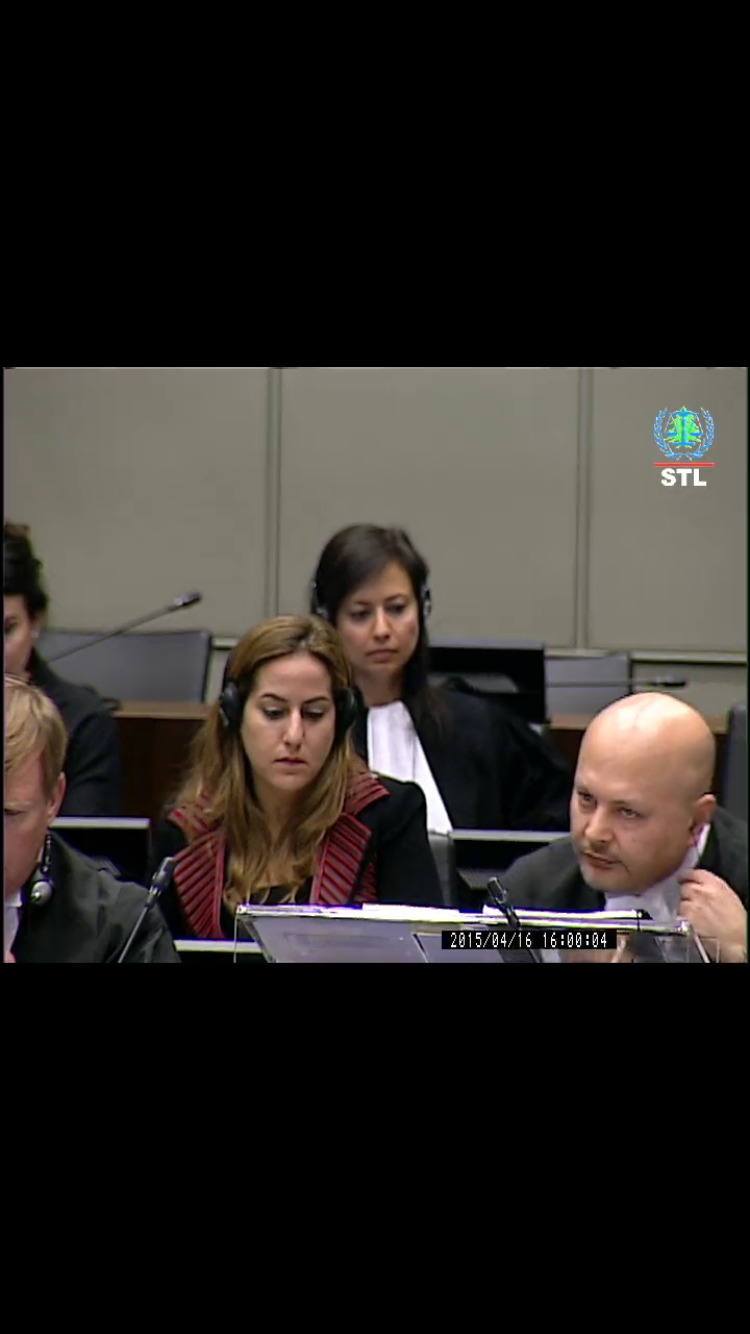

[Ms Karma Al Khayat and her Defence counsel Mr Karim Khan]

Ms Karma Al Khayat also gives a short personal statement, talking about the duties of journalists to uncover the truth and question the authorities. She stresses the importance of freedom of speech and investigative journalism, and questions the amount of money spent on the tribunal by Lebanon. In her view Al Jadeed dared to reveal the failures of the Prosecution, and now it is standing trial for that.

Apr 13, 2015

International explosion experts: Professor Daniel Ambrosini and Professor Bibiano Luccioni

During the last week of February, Professor Ambrosini and Professor Luccioni from Argentina gave evidence. Professor Ambrosini is a structural engineer specialised in the effects of explosions on buildings. Professor Luccioni is a civil engineer with a similar specialisation. 


[Professor Ambrosini (top) and Professor Luccioni testifying before the Tribunal]

Jointly these two professors have submitted a number of reports to the Lebanon Tribunal providing studies of the explosion of 14 February 2005, with the main report entitled “Final Report on the Quantity of Explosives” and prepared in September 2010. This report deals with a numerical determination of the explosive mass based on an analysis of the crater and the damage to the surrounding buildings. These experts calculated with computer models - based on real-life experiments - the amount of explosives that could have created the crater and the damage to the surrounding buildings. The experts also looked into the location of the explosives in terms of height above the ground, and the shape of the explosives. Unfortunately, the expert reports of these two professors, though public in nature, are not (easily) accessible to the public, and without these reports the testimony of these experts was difficult to follow.

Together with other researchers, Professor Ambrosini and Professor Luccioni conducted a series of explosion experiments, which included experiments above the ground, on the ground and underground. This was done in the northern part of Argentina, at a flat location completely void of trees or vegetation; the differences in craters and the amount of soil expelled up above due to the explosions are shown on photographs. These tests were used as one of the sources for the calibrations of the numerical simulations done with computers. For example, the results of various explosion experiments done in France (one using a van elevated on bricks as a container for the explosives) were used as well. According to Professor Ambrosini, the three most important variables that determine the size of the crater are the quantity of explosives, the shape of the explosive, and the location of the explosive.

With a three-dimensional model to reflect the actual situation in Beirut before the blast occurred, Professor Ambrosini explains how the blast wave occurred, and at which buildings it was reflected, including the St. Georges and the Byblos buildings. Professor Ambrosini also explains that from the perspective of the perpetrator it would be the most effective to locate the detonation point on the opposite side of the target’s location. However, the analysis does not permit one to identify the detonation point within the explosive mass. Professor Ambrosini also participated in a real-time, real-life explosion experiment in 2010 in France at the suggestion of the Prosecutor of the Lebanon Tribunal. In this experiment a canter van was used with 2.467 kg TNT equivalent explosives in rectangular form in the back of the van; attempts were made to reproduce as closely as possible the circumstances of the road and surrounding vehicles. A series of pressure sensors were put in positions around the vehicle to locate and identify blast overpressures. The results of this experiment came back as very close to the numerical model designed beforehand.

Professor Luccioni explains the different types of analyses used to analyse the damage to the buildings: a surrounding urban ambient scale analysis (to provide the bigger picture), a building scale damage analysis and a structure scale analysis. Professor Luccioni gives quite some detail about these complex technical analyses, which provide information about for example the blast wave and the overpressure values, and thus about the quantity and shape of the explosives used. One of the main conclusions of the overall analysis is that a "distributed explosive load with a TNT equivalence of between 2.500 to 3.000 kilogrammes, located above ground, at a height between 50 and 80 centimetres from the pavement surface, is compatible with the observed crater and structural damage."

During cross-examination the following topics, among others, are explored by defence counsel: the initial contacts between the Prosecutor and the experts, the review of their scientific work by peers, the uncertainties in the measurement of the diameter of the crater, the alterations that took place after the explosion, and the possibility of an underground explosion. When reviewing the initial information about the explosion, Professor Ambrosini had also thought that the explosion had been underground, but after carrying out the study, they were able to demonstrate that it was in fact not. Professor Luccioni also excludes the possibility of an underground explosion during her testimony. About the way the explosion has been carried out - through a car, a bomb, a missile or otherwise - Professor Ambrosini remarks that “in no moment in time in our report did we say that it was a car bomb or a truck” and “a concentrated load such as a bomb could have generated this crater, created this crater, but it would have caused other types of damage as well.” 

Apr 2, 2015

Evidence by a close friend of Hariri: Mr Ghaleb El-Chammaa

On 10, 11, and 12 February, and 3 March, Mr Ghaleb El-Chammaa, a very close friend and business associate of former Prime Minister Rafik Hariri, gave evidence. Mr El-Chamma testified, among others, about Hariri’s relationship with Syria and the Syrian Presidents throughout the 1990s, including meetings with President Bashar Al-Assad, and payments made by Hariri to Rustom Ghazaleh.

Hariri and Mr El-Chammaa were close friends and they came from the same neighbourhood. Mr El-Chamma accompanied Hariri on most of his trips outside Lebanon and on his way to important meetings, including Hariri’s visits to the Syrian president. Upon his return to Lebanon in 1990, Mr El-Chammaa became involved in setting up the group that provided charity work on behalf of Hariri. Mr El-Chammaa and Hariri shared the dream of ending the war and developing and rebuilding Lebanon.

 [screenshot of Mr El-Chammaa testifying on 11 February 2015]

Mr El-Chammaa tells the court that the adoption of Resolution 1559 led all Lebanese people, including Hariri, to believe it was time to implement the Taif agreement, including the withdrawal of Syria from Lebanon. According to the witness, with the death of the Syrian President Hafez Al-Assad, the relationship of Hariri with Syria changed. The Syrian security organs became the Syrian representatives in Lebanon, with the highest security official in Lebanon being Rustom Ghazaleh. Mr El-Chamma gave evidence that Mr Ghazaleh reported directly to President Al-Assad.

Mr El-Chammaa testifies about the visits by Hariri to President Al-Assad in 2003 and 2004, and the communication exchanged between Hariri and the Syrian authorities. The witness extensively describes a meeting between President Bashar Al-Assad and Hariri, in the presence of three Syrian security officials: Rustom Ghazaleh, Ghazi Kanaan and Mohammed Khallouf.  According to Mr El-Chammaa these three officials were in charge of implementing the Syrian wishes in Lebanon. The meeting occurred in 2003 and is described as a turning point in terms of the relationship with Hariri. Hariri told his good friend Mr El-Chammaa that the tone of the meeting was harsh and that President Al-Assad said "that he was the one to decide who would be president of the Republic of Lebanon", and that "Hariri is behaving in a way that is contrary to Syria’s interests and that he is inciting the Lebanese people against the Syrian presence".  Hariri was a shareholder of An-Nahar newspaper, and President Al-Assad asked him to sell his shares. Hariri told Mr El-Chammaa that he was very upset with the presence of the security officials, and that the meeting was a direct threat to him, to prevent him from achieving his goal, namely seeking a candidate for the presidential elections in Lebanon. Hariri further told him on their way back to Beirut that he was humiliated and that the Syrians should not deal with him in such a way.  Mr El-Chammaa asked Hariri: "Why are you staying in Lebanon? Why don’t you leave Lebanon? And why don’t you leave this kind of unacceptable situation?" Hariri replied that he is not only afraid about what will happen to him, but also about what will happen to those who are close to him.

Mr El-Chammaa also tells the Court about a meeting between Hariri, Rustom Ghazaleh and Charles Ayoub. Charles Ayoub is the owner and editor of the newspaper Diyar, which is pro-Syrian. He had a good relationship with the Syrians and he was in contact with Hariri. The aim of the meeting was the idea to calm down the tension that was prevailing at that time; Hariri was determined to go ahead with his plan to run his own election and to have his own electoral list in all Lebanese Regions. Of course, Rustom Ghazaleh was not happy with this plan. According to polls and studies Hariri would have been able to secure the majority in the parliament, and this majority would enable him to form a cabinet that would serve Lebanon's national interests. This way the Syrians would lose many channels of interference or control over Lebanon and its territory. The Syrians demanded that Hariri would limit his electoral list to certain areas in Lebanon. However, Hariri made up his mind, and did not listen to their request. Hariri was fully determined that he would run his own elections. 

The witness also testifies about the pressure exerted by the Syrians on Hariri to support the extension of President Lahoud, the decreasing of Hariri’s hope in changing the position of Syria vis-à-vis Lebanon, Mr Hariri’s contacts with the opposition, and Mr Hariri’s meetings with foreign heads of states. According to the Prosecution, the relevance of this last item is background evidence showing “the Prime Minister’s emergence on the world stage as a figure of some importance”. The witness further discusses meetings of Mr Hariri with the Secretary-General of Hezbollah, Hassan Nasrallah. Mr Hariri wanted to communicate with Hezbollah and engage them in his attempt to change Lebanon.

Further, Mr El-Chammaa describes his own visits to Syrian officials, including General Rustom Ghazaleh, to relay messages from Hariri. Mr El-Chammaa also arranged for payments from Hariri upon the request of Mr Ghazaleh. This included monthly payments to Mr Ghazaleh from 1993 until 2005 that went up to 67,000 USD as well as separate cash payments as high as 250,000 USD. This was done to "preserve the relationship with him". The witness also remembers that "Abou-Tareq, one day before the assassination, on the evening of that day, he told me that he gave to Rustom Ghazaleh this additional payment" - as Mr Ghazaleh claimed he had not yet received his monthly payment - and that Ghazaleh had said some very insulting and humiliating words to Abou-Tareq, which had scared him. Hariri was also very upset about this, and this was the last time the witness saw Hariri. This evidence seems to point to a link between Mr Ghazaleh and the attack on Hariri, although the exact implications remain unclear. During his cross-examination, Mr Khalil, defence counsel representing Mr Merhi, suggested that the Prosecution is trying to imply that Mr Ghazaleh knew about the assassination and therefore he cashed the amount of money for two months instead of one. The Defence questions this theory as Mr Ghazaleh certainly would have warned Hariri in view of losing his main source of income.

The Defence further questions the witness about his knowledge about the relationship between Hariri and Hezbollah, and the absence of Wissam El-Hassan, a security officer and the secretary of Hariri who regularly accompanied Hariri in his car, on the day of the terrorist attack. The witness does not remember most of the details asked for because of the amount of time that has passed since the events. The same goes for the details from his UNICCC statement of August 2006, about which he’s extensively questioned by the Defence, and which seems to contain quite some facts that are based on hearsay.

Mar 25, 2015

Another political witness: Mr Salem Diab, manager of the election campaign for Hariri

Salem Diab gave evidence on 22-23 January and 3 February 2015. He is a businessman and owner of a long-established company in Lebanon, the Abdul-Rahim Diab establishment. The witness met Hariri for the first time in 1979 in Riyadh, and they became friends. Every time Hariri was in Beirut, they would meet. In 1996 Hariri wanted to have on his list some persons from well-known families from Beirut, including Mr Diab, but Syria opposed his candidature. Instead Mr Diab became the manager for the election campaign of Hariri, first for all kind of elections and subsequently for the campaign for the prime minister. This was a very big machine, more than 3000 people were working for him. Further, Salem Diab was the president of the Beirut Welfare Association (Tanmiya) providing schooling and medical assistance, which was funded by Hariri.


[screenshot of Mr Diab during his testimony on 23 January 2015]

From 2004 onwards Salem Diab spoke with Hariri on a daily basis. The witness did not discuss with Hariri the relationship he had with the Syrians, but Hariri did not want pro-Syrian candidates on the list. Salem Diab heard afterwards about a meeting between Hariri and Assad in 2004, in which Assad told Hariri that he would break Lebanon over his head if Hariri did not accept his offer. Also, Mr El-Hassan and Bassel Fuleihan told the witness that during a meeting between Hariri and Assad, Mr Ghazaleh had a gun in his hand.

Further, the witness explains the chances of Hariri in the elections, the big role of politics in Lebanese society, and the allegations that Hariri was buying votes. The witness denies this, although Hariri used to distribute food to poor people, and he explains what happened when Hariri wanted to help because there was a shortage in olive oil, but this had nothing to do with the political campaign according to the witness.  Mr Diab continues his testimony with a description of the lunches that took place at the Quraitem Palace, with influential people coming over every week on Tuesdays and Fridays. However, the week before his death Hariri was nervous, although Hariri said that 'no one dares to get in any way nearer to me or closer to me'.

The Defence extensively cross-examines Mr Diab about the contradictions in his previous statements in 2005 and 2006, especially in relation to a person that returned to the crime scene after the explosion to remove the motorcade vehicles and/or jammers, an important issue for the Defence as this potentially shows that the crime scene had been altered. The judges also have follow up questions about this issue. Mr. Diab is also asked about several names on a list, which are however revealed from the public. Further, he is asked about his relationship with Sheikh Ahmad Abdel-Al and Mr Mustafa Hamdan, a general and head of the Lebanese Presidential Guard Brigade, and a close aide of President Emile Lahoud. About the close relationship between Al-Ahbash and the Syrian security forces, Mr Diab states that this was ‘common knowledge’. Further, the Defence asks questions about the threats Mr Diab had to undergo.

The day after the testimony of Mr Diab, the Prosecution read summaries of witness statements into the evidence, all Tripoli citizens who had purchased SIM cards in early 2005. According to the Prosecution, the accused used the identities of these citizens to purchase cellphone SIM cards.  

The next political witness: Dr. El-Khoury

From 15th January onwards, the next political witness took the stand: Dr. Ghattas El-Khoury, a prestigious surgeon and former Member of Parliament in Lebanon. He was a close confidant and political ally of former Prime Minister Rafik Hariri. His testimony was extensive and spread over several days of examination-in-chief and cross-examination. During his testimony-in-chief, the witness covered six different topics:

[Screenshot of Dr. El-Khoury testifying in court.]


1. The position of various parties relating tot he extension of President Emile Lahoud in mid-August and beyond, after Hariri's visit to Damascus on 26 August 2004.

During the summer of 2004, Mr. El-Khoury stated he had been responsible for keeping an open dialogue with the Christian Maronite groups and other political parties with the aim of convincing those political opposition groups to elect a new president of the Republic and to respect the Lebanese Constitution. Several groups were in favour of changing the Constitution so as to allow Emile Lahoud a further extension of his presidency. This idea was supported by the Syrian-Lebanese apparatus, according to the witness. Former PM Hariri was reluctant to this idea, but changed his position after visiting President Bashar al-Assad in Damascus. He testified that Hariri had said that the meeting had been "short and inappropriate". He had been made very clear that he had to accept the extension of Lahoud's mandate. Hariri had returned from Damascus being very upset and nervous. Hariri had no choice but to approve the extension of Lahoud and persuade other ministers to do the same.

2. El-Khoury's own position, which was not to support the extension, despite being an ally to Hariri.
The vote on the Constitution's amendment was scheduled for 3 September 2004. Dr. Khoury had decided to vote against the extension, in spite of other politicians' efforts to keep him from doing so. Around that time, the witness and his wife had been receiving threats. Hariri had accepted the witness's position on this, but realised that if more members of his bloc would vote against the extension, it could be suspected that he had given orders to that extent.

3. The discussions that El-Khoury had with Hariri about attending the Bristol gatherings organised by Walit Jumblatt.
Dr. Khoury indicated that after the extension of Lahoud's term, the only option available to form a government of their own choosing was to coordinate all political forces to achieve a strong opposition to Lahoud's group. El-Khoury himself and minister Walit Jumblatt were in charge of this. They hoped to achieve, inter alia, that the President would resign, to win the upcoming elections in May and to implement the Taif Agreement. This was the start of a new political chapter in Lebanon; a wide range of political opposition groups were united in a series of gatherings held at the Bristol Hotel, the so-called "Bristol gatherings". Although it was Hariri who coordinated those meetings, he himself did not attend due to political strategy and security concerns. After the extension, Hariri was asked to form a new cabinet, and it was impossible for him to openly support the opposition groups. Further, after his resignation in October 2004, Hariri preferred to be represented by Dr. Khoury and Bassel Fuleiham, in order to have a wider margin of manoeuvre.

4. The position of Hariri's views regarding the bloc in the upcoming elections in May of that year.
Dr. Khoury mentioned Hariri's reluctance to include pro-Syrian candidates in his electoral list, though he was told by Rustom Ghazaleh that he should include several pro-Syrian candidates in his list if he wanted to win the elections.

5. El-Khoury's activities on the day of the assassination.
On the day Mr. Hariri was assassinated, Dr. Khoury went to the hospital to visit his patients. Afterwards, he visited Parliament together with Mr. Fuleihan. He joined Mr. Hariri in a cafe facing the Parliament, and left the cafe to return to the hospital for an operation on one of his patients. Minutes later, he heard an explosion and described how wounded people started arriving at the hospital. Bodies arrived, including former Prime Minister Hariri's. Mr. Fuleihan arrived at the hospital, badly injured before ultimately passing away.

Cross-examination
After giving his chief testimony, the witness Dr. Khoury was examined by the various defence teams. Defence counsel Mr. Iain Edwards questioned the witness about whether Syria's reputation would suffer from such an attack on Hariri. The witness responded that he was not in a position to assess Syrian relations vis-a-vis the international community, but added that in his view, Syria did not care about the international community. Other defence counsel suggested that other groups in Lebanon, political opposition groups, may have been interested in the disappearance of Mr. Hariri, but the witness responded that no one else was responsible for the assassination of Mr. Hariri.

With Dr. Khoury's testimony, the Prosecution continued leading political evidence pointing to Syria's involvement in the assassination of Mr. Hariri, departing from its earlier position where it took no position on any political or other motive for the assassination.

Jan 28, 2015

Journalist Mr. Salman testifies from Beirut

On 8th January, Prosecution witness Mr. Faisal Salman testified by video link from the STL office in Beirut. He is both a media advisor and a journalist for Future News, and was present in the Café de L’Étoile at the invitation of the late Prime Minister Mr. Hariri, when the latter left Parliament and walked across the square and entered the cafe just prior to the assassination on Valentine's Day in 2005. The witness had had frequent contact with Mr. Hariri and they had a strong personal relationship, telephoning each other several times per week.

[Screenshot of Mr. Salman]

The witness speaks about the political preferences of Mr. Hariri, including the Taif Agreement. Hariri would say that the Taif Agreement was clear, and that the Syrian presence in Lebanon was necessary, legal and provisional. From the mid-1990s until 2000, Mr. Hariri avoided to talk about the Syrian presence in Lebanon with journalists. According to this witness, Mr. Hariri would later say that "it is not an imperative necessity to have a Syrian presence in Lebanon, […] those who protect Syria are the nationalists in Lebanon".

There were several contentious issues that were being discussed in Parliament at the time, including Syria's presence in Lebanon, Hezbollah's weapons, economic policies in the country and the extension of President Lahoud's mandate.

It had been Abu Tareq aka Yahya El-Arab, Mr. Hariri's security officer, who had invited the witness and another journalist for coffee at the Café de L’Étoile on the 14th February 2005. The other journalist was Mohammed Chqeir, also a close friend of Hariri's. There were several other colleagues also present at the cafe that day. When Mr. Hariri arrived at the cafe that day, he talked about his position on UN Security Council Resolutions 1559 and 1566 dealing with the situation in Lebanon. Mr. Hariri did not make a particularly worried or afraid impression, according to the witness. Whilst at the cafe, Hariri had said that Lebanon cannot be governed from Syria.

Jan 9, 2015

Syria in the dock: Witness Hamade testifies at the STL

The week of 17 November started with the second part of the Prosecution's case at the Lebanon Tribunal. This phase will consist of some twelve parts, starting with several witnesses providing background evidence of certain political events prior to the 14 February 2005 assassination. Mr. Marwan Hamade is the first Prosecution witness to testify in this second phase, and he spent eight days in the courtroom providing testimony to the Court.

Defence attempts to block Mr. Hamade's testimony
During legal arguments preceding the testimony of Mr. Hamade, the Prosecution asked the Trial Chamber to allow it to present evidence against the Syrian regime and its President Bashar Assad in its case. The Chamber indeed allowed the Prosecution to go forward and the first political witness the Prosecution called to the stand was Mr. Hamade.


[Screenshot of Mr. Hamade testifying before the STL.]

Mr. Hamade was a close political associate of Mr. Hariri and a Lebanese cabinet minister who was intimately involved in many of the events at the time and was himself victim of an assassination attempt in Lebanon in October 2004, a case that might also be subject to further investigations by this Tribunal. He is currently a Member of Parliament and deputy for the Chouf District. On 13 November, the Prosecution outlined that Mr. Hamade's testimony (and the testimony of twelve further Prosecution witnesses) would highlight five themes: (1) Mr. Hariri's deteriorating relationship with Syria as a consequence of his goal to strengthen Lebanese autonomy; (2) Syria's corresponding increasing resolve to exert control over Lebanese internal affairs; (3) growing concerns voiced by the international community regarding external pressures bearing upon the political affairs of Lebanon; (4) the evolution of an effective opposition movement since September 2004 of which Mr. Hariri was first a silent and then a more public participant; and (5) Mr. Hariri's status as an influential statesman in the Gulf region and beyond. 

With Mr. Hamade's testimony, the Prosecution hopes to bring to light the political tensions prevailing at the time preceding Mr. Hariri's assassination, and though it fails to specify a motive in the indictment against the five accused, arguing that the accused's personal motives are either non-existent or irrelevant, it hopes to bring to light the political motives for the assassination by providing these witnesses' testimonies to the court. Defence counsel vehemently objected to the hearing of Mr. Hamade's testimony in regard of his meetings with Syrian President Assad and Mr. Hariri as well as General Rustom Ghazaleh, the Syrian chief of intelligence in Lebanon at the time. The basis for their objection was that aspect of his proposed testimony was irrelevant and not pleaded in the indictment or the Prosecution's opening statements. However, the Trial Chamber ruled that the STL has an inclusionary approach towards receiving evidence, and that it may admit any relevant evidence. It regards evidence of the prevailing political situation in Lebanon in 2004 and early 2005 as potentially relevant and thus allows the Prosecution to call Mr. Hamade as a witness.

Testimony-in-chief of Mr. Hamade
The witness began his political career in 1977 and was almost continuously a Member of Parliament until 1990 and also held significant ministerial positions. He testified about the process of limiting Syria's role in Lebanon, starting with the Taif Agreement in 1989 between Lebanon, Syria and Saoudi Arabia that envisioned national reconciliation between Syria and Lebanon. In describing the years following this Taif Agreement and subsequent agreements between the two countries, the witness describes the relationship between Lebanon and Syria as follows:
"the years that followed, the first years, were years of hope. The years that followed those were years of deception and the last years were those of breaking down and despair."
The agreements, instead of as depicted by its texts leading to close cooperation, led to influence, intervention and hegemony by the Syrian state. He explained that the agreements were accepted by him and Mr. Hariri 
"a Syrian umbrella over Lebanon, but we considered that this umbrella would be lifted gradually with the reconstruction of Lebanon, with the reconstruction of Lebanese institutions, the disbanding of the militias, and the withdrawal, the complete Israeli withdrawal."
The witness further noted that when the father of the current Syrian President, Hafez Assad, passed away, there were many promises and hopes that Syria would become more open, though in fact, the opposite happened. Syria's grip on Lebanon became tighter, and President Hariri was restricted in the formation of his first and second governments in 2000 and 2003 respectively. Hamade stated that "we were facing a group that wanted to influence more and more the Lebanese institutions, political, security, economic and financial institutions". The witness depicted Mr. Hariri as a man of compromise, someone who would always continue to talk to the enemy. But by April 2003, Mr. Hariri was completely paralysed, and Syria wanted to pave the way for the re-election of Emile Lahoud as president, though they pretended that Lebanon would be free to choose its president. 

From the year 2000 onwards, freedom in Lebanon was more and more reduced because of Syrian tutelage.  The witness also extensively spoke about the period from 2003 onwards, when Mr. Hariri returned from a visit to Damascus; "he was humiliated by the president of Syria to prove that the people in charge in Lebanon were considered as no one, nothing, to the Syrians and no one should mistake the orders of Damascus". Mr. Hariri was forced by Al-Assad to cooperate with General Emile Lahoud, the Lebanese President who was acted in the name of the Syrian regime. However, Mr. Hariri did not accept full hegemony by Syria and their intelligence on Lebanese politics. In 2003/2004, the witness describes that Mr. Hariri and Mr. Lahoud's relationship had severely deteriorated. He also indicated that Syria was wire-tapping the telephones of Mr. Hariri and Mr. Walid Jumblatt, leader of the Progressive Socialist Party in Lebanon.

Mr. Hamade stated in this regard that Syria pressured Lebanon to transform its democratic parliamentary system to a presidential system where President Emile Lahoud was to grab all power and all other political actors would be subsidiary to his power. Instead, Mr. Hariri was attempting to form a government of national unity, a neutral government consisting of moderate ministers. 

Under pressure from Syria, Prime Minister Hariri resigned from his post on 20 October 2004. After his resignation, the campaign against him aggravated, very openly. The international community had made a resolution that demanded the withdrawal of all non-Lebanese forces from Lebanon, and the pro-Syrian forces accused Mr. Hariri of having encouraged this; however, witness Hamade testifies that Mr. Hariri had not been involved in this. Mr. Hariri had been confident about winning the next elections in Lebanon in the Spring of 2005, in spite of all actions taken by Syria. Though information about Mr. Hariri's safety being threatened became more intense, according to witness Hamade, he was never sufficiently concerned about his own safety. 

Cross-examination of Mr. Hamade
In cross-examination, Mr. Hamade testified to the cooperation between the late Mr. Hariri and Hassan Nasrallah, Secretary-General of Hezbollah, and their creation of an alliance for the legislative elections of 2005. Badreddine's lawyer Antoine Korkmaz suggested that there was a broad alliance between Mr. Hariri and Hezbollah, thus undermining the Prosecution's theory that the relationship between these two had severely deteriorated in the period leading up to the assassination on 14 February 2005. After the assassination, Mr. Hamade secretly met with Hezbollah leader Nasrallah, and he asked the latter about Hezbollah's involvement in the attack on his own life at the end of 2004. He denied Hezbollah had anything to do with that, but when he asked "Did the Syrian brothers have a role?", Nasrallah responded by saying that he did not know. 

In cross-examination, counsel for Badreddine Mr. Korkmaz attempted to discredit this witness by saying he was biased against the accused persons, basing his questioning on previous interviews given by Mr. Hamade to the Lebanese press. The accusation that he lacked neutrality did not affect Mr. Hamade very much, who simply responded by saying that he is a political figure and that his statements should be understood in that light.