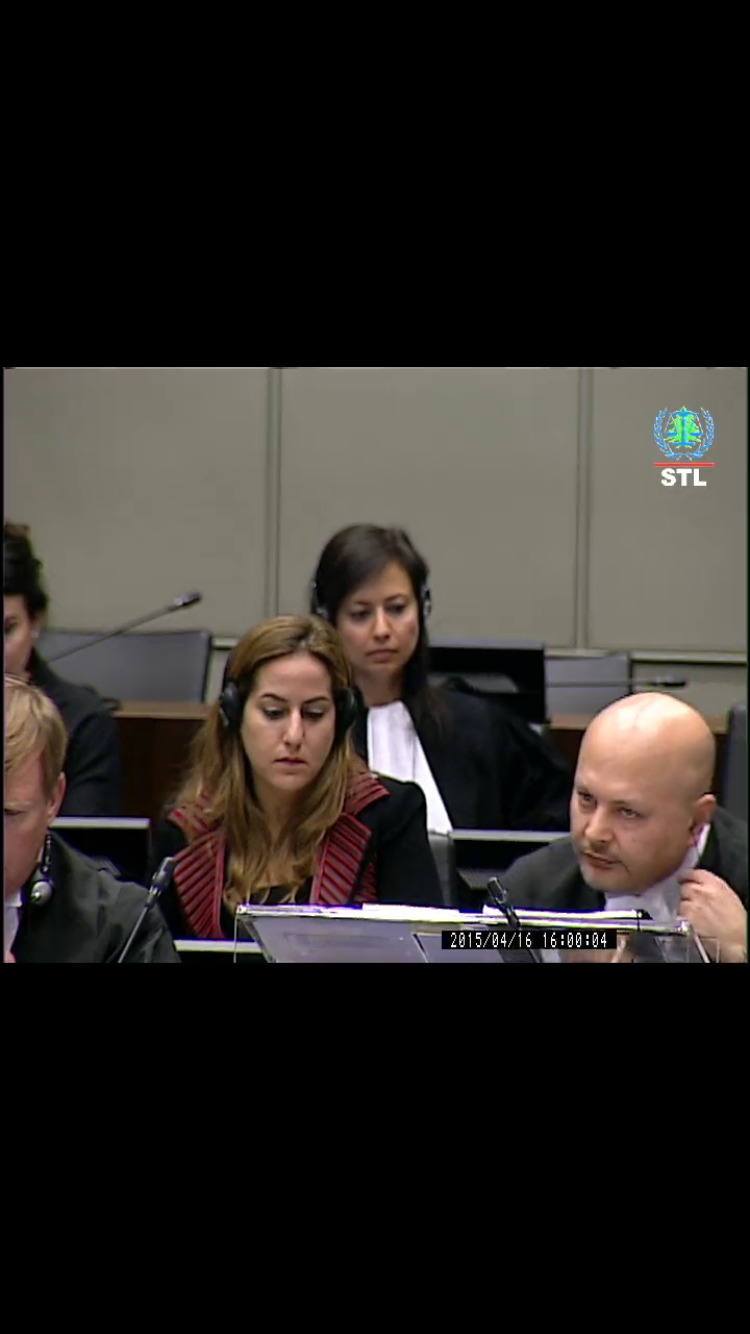
On 9 April, our intern Ms. Sivan Serbest interviewed Dr. Antonios Farouk Abou Kasm about his position as assigned defence counsel for Akhbar Beirut S.A.L. and Mr. Al Amin. The interview is published below.
[Screenshot of Dr. Abou Kasm in court, 12 September 2014.]
Can you briefly describe how you were assigned to this case?
At the initial
appearance of the Accused Mr. Ibrahim Mohamed Ali Al Amin and Akhbar Beirut S.A.L.
on 29 May 2014, he Mr. Al Amin, representing himself and Akhbar Beirut S.A.L., attended the first part of the hearing via
video-link from Beirut, but then left before the hearing had concluded because
of a misunderstanding with the Contempt Judge Nicola Lettieri, who interrupted
him during the reading of his statement which considered beyond the Tribunal's jurisdiction.
Before asked for permission to leave, Mr. Al Amin informed the Judge that due
to his interruption, he would henceforth remain silent and would refuse to
appoint any lawyer to represent him or Akhbar
Beirut S.A.L. and indicated that he would remain silent adding that he did
not recognize the Special Tribunal and that he was not willing to accept
"oppressive and repressive measures".
Then and orally,
the Contempt Judge ordered the Head of Defence Office to assign counsel to
represent the two Accused in the proceedings under Rule 59 (F) of the
Tribunal’s Rules of Procedure and Evidence. This order was followed by written
reasons provided on 5 June 2014, where the Judge Lettieri stated that despite
his order, which was made to safeguard the rights of the Accused, the Accused
remained free to participate in the proceedings and to appoint counsel of their
own choosing at any time.
Subsequently, on 18 June 2014, the
Contempt Judge ordered the Accused to make submissions on (1) their intention
to participate in the proceedings and, if so, (2) to state whether they would
appoint counsel or represent themselves. One week later, on the 25th, the
Accused filed a submission in which they raised a number of allegations with
respect to the neutrality and impartiality of Judge Lettieri in hearing the
case.
When Mr AI Amin did not respond to
the several requests for clarifications on whether he intends to
participate in
the proceedings, on 30 June 2014, and following a written order by the Contempt
Judge, the Head of Defence Office, and being admitted on the list of the STL’s
counsel since 2011, Me Francois Roux took the decision to assign me as a Lead
Counsel to defend the interests of the accused under the legal aid programme of
the Defence Office, he believes that I am the adequate person who can lead the
defence of the Accused in that critical case. I accepted this assignment as a
challenge after the consultation of the President of the Beirut Bar, who told
me that it is an obligation to defend an accused who cannot or refuse to defend
himself.
What would you say are the main problems in this case for
you?
There are
several major problems.
First, and as
you may know, it is the first time that a legal person is sued before an
international or internationalized criminal tribunal and because there is no
legal provision within the Statute or the Rules of procedure and Evidence of
the Tribunal or even within the jurisprudence of other international criminal
courts, this involve to innovate with regard to the elements of the offense
apply to a legal person.
Then, the
Accusation did not make available to the Accused the exhibits accompanied the
indictment and all the witness statements and all supporting material. It is
not fair at all to charge an accused and to ask him to participate in to his
trial without being informed of his charges because he is represented by an
assigned counsel!
For example, in
Lebanese law (Code of the criminal procedures), if the Proceedings that are
conducted without ensuring that the indictment and the list of witnesses for
the prosecution have been served on the accused, as well as the resulting
judgement, are liable to annulment. Indeed, it’s a violation of the principle
of equal arms mentioned in the Article 6§3 of the European Convention on Human
Rights, mainly that the accused are not judged in absentia. The Statute
of the Tribunal accord to him minimum guarantees as the rights to examine all
incriminating evidence produced during the proceedings, mainly to examine the
witnesses against him and to obtain the attendance and examination of witnesses
on his behalf under the same conditions as witnesses against him. Because the
Accused have not received this material, their rights are being violated,
leading to prejudice and the lack of contact between me and the Accused should
not deprive them of their rights to see the case file.
To date, the
Accused have not had cognizance of the evidence disclosed by the Amicus and do
not have in their possession other items from the case file. Under the current
circumstances, the prejudice caused to the Accused is compounded in view of the
seriousness of the charges laid against them and the sentences that might be
imposed. Furthermore, in the absence of disclosure of all the evidence in the
case file, the Accused are deprived of their right to consider an informed
defence strategy which might encourage them to reconsider their position vis-à-vis
their mode of participation in the proceedings.
As well, it is
impossible for the Assigned Counsel to do an inquiry and to search for
witnesses to defend the accused without his approbation, we are defending a
free and innocent man, the accused shall be presumed innocent until proved
guilty by the Judge and not by the Accusation. And till now, the Accused have,
from the outset, respected the confidentiality of the investigation conducted
by the Amicus and didn’t violate the confidentiality and protective measures
imposed by the Judge's decisions. So, pretending that the Accused will
divulgate the Prosecution’s exhibits is an inadequate presumption, as if we are
judging the pre-intention of the Accused not based on any concrete fact.
You have a client who
refuses all contact with you, but a judge who tells you it’s your
responsibility to effect disclosure to him. How do you go about with this?
The judge has
considered that Counsel's responsibility reaches its limits where an accused
refuses to cooperate with him. But if the Accused decline to receive the
material disclosed by the Amicus from Counsel, or even be in contact with Counsel,
it is not up to the Court to dictate to them whether and how to exercise their
right. This is the Accused's choice alone.
Such decision
can be interpreted that the Tribunal prefers not to disclose the exhibits to
the Accused, because they are aware that he will refuse to be in contact with
the Assigned Counsel in order to examine his exhibits. In the light of this
decision, I asked the cooperation of the Defence Office in order to give the
chance to the Accused to examine the disclosed material.
Do you think the rights of the accused are safeguarded in
this manner?
Not at 100%! In
criminal justice, the role and the presence of the accused during the trials is
essential and prominent, mainly that the Mens rea constitutes a basic
element of the Defence strategy. But in case that an accused refuses to
participate in his proceedings, to have an Assigned Counsel to defend his
rights constitutes at least a guarantee that his rights and interests are
protected during the proceedings. Despite the effectiveness of a Defence team,
the presence of the accused still essential, an Assigned Counsel cannot pretend
the Accused intentions.
How do you think the judge would have better solved this
situation?
I think that the
Judge should grant to the Accused or the Defence the certification of the
Appeal of his decision on assignment of counsel in order to give them the
opportunity to submit an appeal before an Appeal panel who can decide on this
particular case of assignment before the STL. Mainly, that before my
assignment, the Accused filed on 12 June 2014 a request in which they sought
certification to appeal the Judge decision "Reasons for Decision on
Assignment of Counsel" dated 5 June 2014, as well as suspension of that
decision on a Decision. On 17 July 2014, the Judge rendered the decision
entitled "Decision on the Request for Certification to Appeal Decision on
Assignment of Counsel" by way of which he dismissed the Request of the
Accused seeking leave to lodge an appeal of the contested decision. On August 1st
and after my assignment, we submit a request for reconsideration of the Judge
decision above. By its decision dated September 1st 2014, the Judge
dismisses also our motion.
What further steps are you intending to take in this regard?
I am managing a
delicate situation: I am defending momentarily the interests of the Accused, as
if I am trying to rescue shipwrecked people of a sinking ship. The ultimate
solution is the participation of the Accused to defend themselves or to appoint
counsel from their choice. It is the ideal period to take such decision before
the beginning of trials, mainly that the Defence Case file is ready and up to
date. And if they still refuse to participate, I will think what decision I
shall take to guarantee the safety of the Accused and to avoid any bad
situation can be occur. For me, I respect the will of the Accused if they don’t
want to participate, but also they are responsible finally of their decision’s
effects.