Oct 15, 2014

Testimony by Dr. Murray on the chemical analysis of explosives used in the attack


On 29 and 30 September, Dr. Gerard Murray came to the stand to testify about specific tests as part of the wider investigation in cooperation with Dr. Van der Craats, the forensic scientist from the Dutch Forensic Institute (NFI), who testified several weeks prior to Dr. Murray's testimony (see here).

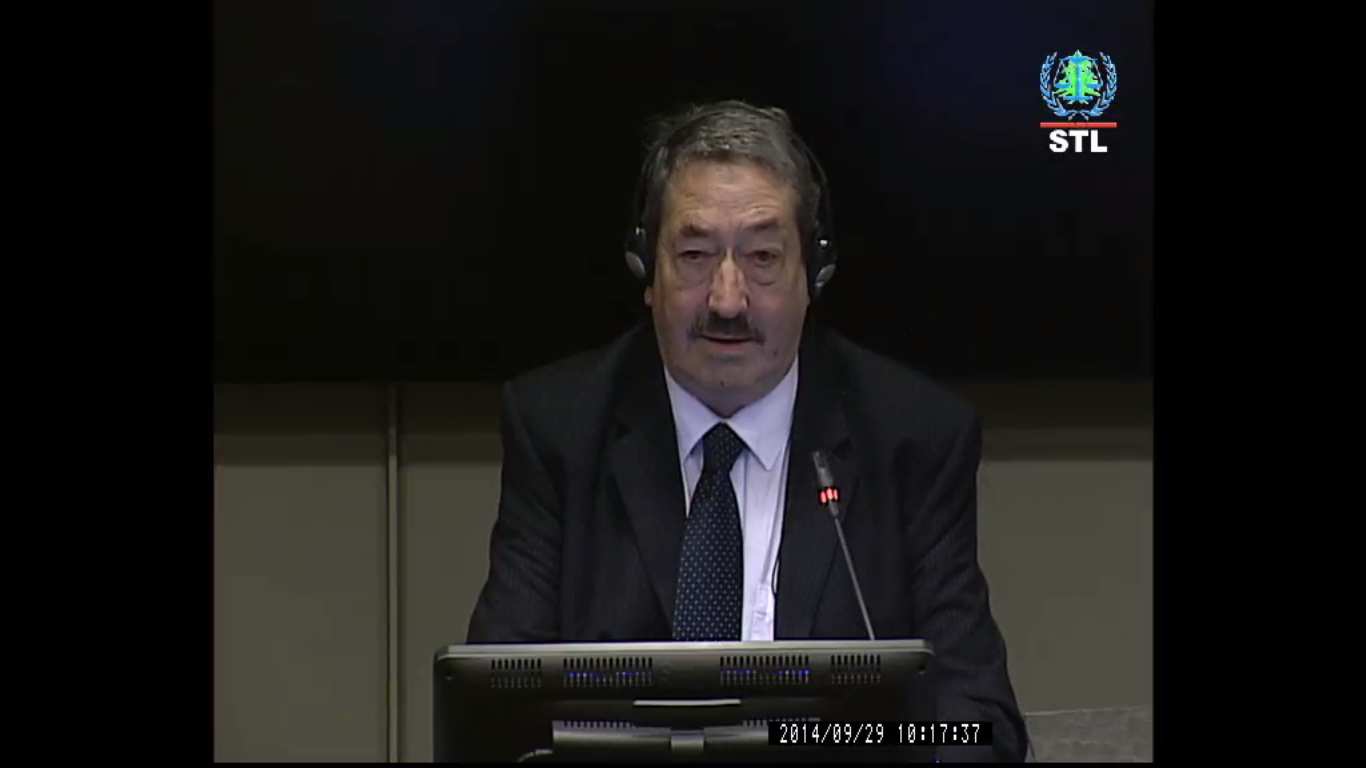
[Screenshot of witness Dr. Gerard Murray]

Dr. Murray is a British specialist in analytical chemistry. He has dealt with many explosions during his 40-year long career in the UK, and was invited by the Dutch investigators' team to join their investigation. Together with Dr. Van der Craats, the witness examined which of the items recovered from the crime scene were suitable to examine for explosives residues. The analysis of the swabs taken by the witness was done in a laboratory in Northern Ireland. The witness visited the crime scene in order to observe the damage that had been caused. The witness was not involved in the actual collecting of the evidence, but only the examination thereof. 

The testing in the laboratory consisted of so-called high-pressure liquid chromatography, consisting of two series of tests, the first series is an attempt to identify if any materials of significance are present, the second series to confirm the presence or absence of such materials. The tests look for the most commonly experienced organic explosive materials in Northern Ireland (inorganic residues are so common in the general environment that there is no point in looking for them). 

The witness describes the traces of explosives they discovered at the crime scene items. On several of the swabs, witness found traces of the explosive RDX, a very powerful high explosive, and a component part of the plasticised explosive Semtex. It is not possible to tell whether the explosive Semtex was used, only that an RDX-based explosive was used. The witness also explains the possibility of the Prosecution's theory that a suicide bomber drove a Mitsubishi Canter van to the location to detonate the bomb there. The most likely scenario being that the Mitsubishi van contained an improvised explosive devise in the back of the vehicle. A less likely scenario would be that of a remotely controlled device. The witness informs the court that in his view it is relatively easy to acquire the components to make RDX. The witness believes the explosive used was obtained from Libya, but this is information he received through conversations with police officers and through the media.

In cross-examination, the witness is asked about possible cross-contamination of the explosive residue. He indeed indicates that such cross-examination can take place. He is specifically asked whether the residue found at the crime scene could have been the result of cross-contamination, but the witness was not present when the swabs with the residue were taken from the crime scene, so he states that "all I can say, Your Honour, is that RDX was detected on those swabs. I can't elaborate on how it got to be there." 

In cross-examination, counsel for Mr. Badreddine Mr. Edwards, asks the witness about precautions to protect the evidence, normally taken at a crime scene, obviously with regard to the lack of precautions taken at the crime scene in Beirut and the ensuing lack of credibility of the evidence coming from that crime site, e.g. the exhibits swabbed were only taken some seven months after the explosion. He recalls the items were laid out in the open in a hotel room in Beirut, and admits that items may have been cross-contaminated, which may be an important element for the defence.

Appeals Chamber of the STL decides it can prosecute legal persons for contempt

For our analysis of the 2 October 2014 Appeals Chamber decision on the jurisdiction over the media corporation, please see our guest blog on the website of the International Justice Monitor.


Witness PRH155: Spanish police inspector

Witness PRH155, testifying under that pseudonym, is a Spanish police inspector working on anti-terrorism cases. He has extensive experience in relation to investigating car bombs: his first voluntary posting was in the north of Spain, were the ETA terrorist movement was very active.

Witness PRH155 was in charge of the Spanish 9-member investigation team that went to Beirut in 2006, investigating the bombing of former Prime Minister Rafiq Hariri's motorcade; their final report is dated 14 July 2006. The witness and his team conducted a final investigation of the crime scene, though this was some fifteen months after the explosion had taken place. The witness concedes that it is not an ideal situation to investigate a crime scene some fifteen months after the crime. The site had already been manipulated and adjusted by previous investigation teams, but they specifically searched for areas that may have been overlooked or left out by previous investigators.

 The witness indicates that in spite of his extensive experience in Spain, he had never been confronted with an investigation like the one in Beirut, where there were so many items found. The Spanish investigation team found several biological and other items; nine thereof were identified as coming from the 'unknown man' (we blogged earlier about this 'unknown man', see here). One of the judges asked the witness how in his view it was possible that they still managed to find new pieces of evidence some fifteen months after the attack, after so many investigative teams had already examined the area, and the witness attempts to answer this by saying that perhaps immediately subsequent the attack people were not sufficiently calm to proceed with caution to examine a crime scene like that.

The witness further testified to certain shortcomings in the preservation of the crime scene, including the heavy machinery used, the piling up of rubble, and the fact that they were the last team on the scene after many others had already investigated the area.

In his testimony, this witness also testifies about the shortage of time given to do the investigation. He had attempted to convince the UN to give their team more time, but the UN explained that the time period was not negotiable.

We would like to thank our intern, Ms. Eleonore Kahn, for her analysis of witness PRH155's testimony for this blog post.

Oct 8, 2014

Prosecution witness testifies about DNA identification of bone tissue

On 30th September and 1st of October, Dr. Reza Gerretsen testified for the Prosecution, another witness from the Dutch Forensic Institute (NFI). Dr. Gerretsen is a forensic anthropologist who, some seven years after the 2005 bomb explosion, made a selection of human bone tissue for DNA analysis of materials that had not previously rendered a clear DNA profile. This witness had prepared expert reports with his NFI colleague Dr. Kokshoorn. As a forensic anthropologist, his work focuses on the forensic identification of bones, teeth and areas of the body surrounding those tissues. He examined specimen of body parts, trying to identify what they were, whether they were human bones or not. He would then determine whether it contained sufficient DNA for analysis and determination and send it on to a DNA specialist for profiling.


[screnshot of witness Dr. Gerretsen]

The difficulty, as with so many other expert witnesses, is here that the underlying expert reports are not publicly available, though they are not confidential and openly discussed in the courtroom. This makes it especially difficult to understand the proceedings, specifically where they concern the details of the experts' reports.

In responding to questions by Prosecution counsel Mr. Milne, Dr. Gerretsen testified about the long process of DNA identification of bone and soft tissue. With respect to items that could not have previously been profiled, six clear DNA profiles were identified by this method. One of the DNA profiles belonged to a person who is still alive, but was injured during the attack.

The witness testifies on the possible deterioration of human bone tissue through storage, freezing and defrosting, the temperature it has been stored in, the acidity, the presence of bacteria

Part of defence counsel's cross-examination on 1st October evolves around the administrative aspects of the DNA profiling examination. The witness testifies that the budget for the NFI's examination was limited, and that certain pieces of tissue may have led to identification, but that it had been decided by the Office of the Prosecutor not to have them submitted for DNA analysis, even though they may have had fruitful results.

Oct 6, 2014

Two members of the Dutch forensic team that investigated the crime scene in August 2005: Anick van de Craats and Jan Kuitert

Dr Anick van de Craats (who testified on 28 August and 1 September 2014) works at the Netherlands Forensic Institute (NFI). In 2005 she was working as a forensic explosives scientists at the NFI and she was part of the team that was sent to investigate the crime scene in Beirut following a request of UNIIIC to the Dutch government. The team was tasked to find physical evidence and reconstruct the improvised explosive device (IED) which caused the explosion. One of the tasks of Dr van de Craats was to write the report on behalf of the Dutch forensic team. This team was further composed of six colleagues with forensic police experience.

The team was in Beirut from 11 August until 25 September 2005, that is some six months after the explosion occurred. They checked all vehicles within a specifically defined crime zone, searching for objects outside and underneath the cars. After the cars were searched, they were removed from the crime scene. During the first three weeks the focus was on searching the crime scene; after that the team analysed and sorted all vehicle parts that were collected from the crime scene. They were assisted by other experts in recognising the vehicle parts, including Prosecution witness Mr. Geyer (click here for a summary of his evidence). Dr van de Craats took swabs from some of the items which may have had explosive residue upon them. These swabs were taken in consultation with Dr Murray, another Prosecution witness, and subsequently sent to Northern Ireland for Dr Murray to analyse, whilst separate samples were also examined by the NFI to compare the results.

Dr van de Craats explains that it is important to look at the overall damage at the crime scene, including the damage to the buildings and vehicles, to establish the type of explosion that occurred. The damage to the buildings and vehicles showed that the explosion occurred because of a detonation and had an enormous high velocity, which caused the complete destruction of all material in the near vicinity. This also explains why there is a crater. A detonation also can cause ceilings or walls to be moved, and this type of damage was found at the St. George and Byblos hotels. Further, the horizontal perforations of the vehicles show that there had been a horizontal blast force. Based on this and other characteristics of the crime scene (bent columns at the St. Georges Hotel and a slided wall at the Byblos Hotel) Dr van de Craats concludes that it must have been an explosion above the ground. The movement of asphalt is not conclusive for either an underground or above-ground explosion.

The team also had the opportunity to examine the convoy vehicles, which were retained at the Helou barracks, a guarded police compound; although these vehicles were covered by blue plastic they showed sever rust. The damage to these cars was used to determine their position to the explosion centre. The team compared the remains of the three most damaged vehicles: the black Mercedes 404, the Red Ford and the Mitsubishi Canter. They concluded that the Mitsubishi Canter was the most damaged vehicle, with only small parts being recovered, therefore supporting the hypothesis that this was the bomb-carrying vehicle. Further, the Red Ford could not have contained the IED because the damage to the carcass came from the rear left and thus from the outside the vehicle.

During cross-examination, Mr. Edwards (representing the interests of the accused Badreddine) is confronting the witness with the differences between the position of vehicles at the maps of the crime scene drawn by the Dutch team, and the maps of the Lebanese police (ISF). According to a comparison presented by Mr. Edwards, the difference between the maps show addition and removal of vehicles. Dr van de Craats explains that it is difficult to state if these are real differences, given a lack of a common reference points, and if so, what would be the reason for those differences. Also, she states that these differences do not affect the conclusions of her report. Dr van de Craats further explains that at the time of the investigations they already noted the differences, but “we talked to the UNIIIC investigators and we all accepted the fact that we could only start our crime scene search six months after the explosion occurred, and our task was to record the crime scene at that moment as best as we could.” The Prosecution does not dispute that the convoy vehicles and at least one other vehicle were moved; further, it takes the view that the variations in the maps are “simply map-drawer's perspectives”.

The Dutch forensic team further included a number of police officers with specific crime scene experience, one of them being Jan Kuitert, a (now retired) crime scene investigator from the police with experience in explosives. Jan Kuitert gave evidence on 11 September 2014. He explains that each Dutch team member was assigned 4-5 Lebanese police investigators, and they systematically searched the crime scene; the team inspected and removed over 100 vehicles, and located and photographed numerous car parts.


[screenshot of witness Jan Kuitert]

The overall conclusions of the Dutch report "Forensic investigation of the explosion which occurred on the 14th of February, 2005, in Beirut, Lebanon." of 30 September 2005 are as follows:

(i) Detonation of high explosive “The damage inflicted on the buildings, vehicles, surrounding lamp-posts and other objects in the vicinity of the explosion site demonstrate that a large amount of high explosives was activated and detonated to the left side in front of the main entrance of the St. Georges Hotel on the Rue Minet el Hos' n. This detonation set fire to many vehicles within a distance of 20 to 30 metres of the explosion centre. From the damage pattern it was clear that it was one explosion of a charge of high explosive.”
(ii) The Mitsubishi Canter as bomb vehicle “Regarding the physical evidence recovered, the human remains identified by Dr Ayoub, the HSBC security video, and the damage on vehicles parked on the road, the most likely scenario is that a Mitsubishi Canter van containing the improvised explosive device (IED) was activated when the Hariri convoy of six vehicles drove by. The engine number of this Mitsubishi Canter was found among the debris on the crime scene. This number led to the vehicle registration number and the production date of Mitsubishi Canter van which was manufactured in Japan.
No remains of the constituents of the IED have been found among the debris, apart from the vehicle parts of the Mitsubishi Canter in which the IED was most probably placed. Because of the size of the explosion and the exploded charge this is not unexpected. A few damaged parts of circuit boards have been recovered which may be related to an activation mechanism. However, these circuit boards should first be examined by electronics experts, who might give an indication of the origin and application of these boards.”
(iii) Location of convoy vehicles and bomb vehicle “When the explosive device was activated, the Mitsubishi Canter was parked almost in line with the other parked vehicles along the pavement in front of the St. Georges Hotel with the front of the vehicle facing west. It was not parked fully in line judging from the direction of the explosion force acted on the red Ford vehicle which was most likely parked directly in front of the Mitsubishi. This red Ford vehicle was most severely damaged from the left rear side which means that the Mitsubishi could not have been parked fully in line with the red Ford vehicle.
Of the six convoy vehicles, the black Mercedes numbered 404 was closest to the explosion centre when the IED detonated. The direction of the explosive force on this vehicle was from the right side, meaning it was most likely located alongside the Mitsubishi. From the damage patterns it can be stated that the vehicles 401, 402, and 403, the latter with Hariri and Fuleihan as occupants, had just passed by the Mitsubishi when the explosion occurred. Vehicles 405 and 406 have been damaged most severely at the right front side, meaning that these vehicles had not yet driven by the Mitsubishi at the moment of the detonation.“
(iv) Activation of IED “Regarding the physical evidence presented in this report and the fact that small human remains of an up-to-now unidentified person have been found and no large body parts, such as legs, feet, or underarms, the most likely scenario for the activation of the IED is a suicide bomber. Another only less likely possibility is that of a remotely controlled device. However, no residues of such device have been recovered from the crime scene.”

Mr. Kuitert gives a good explanation of the most important caveat to the conclusions of the report because of possible contamination of the crime scene by stating that “when you carry out an investigation half a year after the incident and even if the crime scene has been under surveillance during that time, you can never be sure that the crime scene is as it was shortly after the explosion.”
Sep 19, 2014

Explosive Experts of the Lebanese Police: Mr. Walid Othman, Mr. Mahmoud Khashab, and Mr. Husein Krayem

On 2, 3 and 4 September, Mr. Walid Othman testified for the Prosecution. Mr Othman is an explosive expert within the Explosives Bureau of the Internal Security Forces (ISF) of Lebanon, and since 1986 he has been involved in defusing or dismantling bombs, and visiting crime scenes after an explosion took place. Explosions occured on a daily basis in Lebanon.

On 14 February 2005, within half an hour after the explosion, Mr. Othman and his colleagues were at the crime scene. There was chaos, there were people and mechanical parts spread all over the place. The witness and the three other members of his team went into the crater, which was still hot, and found several pieces belonging to the vehicle in which the bomb had been placed. Various photographs confirm their presence in the crater. As soon as the witness looked at the damages, the crater and the crime scene itself, he thought that this was a car bomb that had exploded; this was based on his previous experience. The pieces of the vehicle were placed in bags and no photographs were taken of the pieces at that time; these pieces were taken to their office. They also took the measurements of the crater.

In the following days the witness and his colleagues collected more car parts at the crime scene, both from inside and outside the crater. The witness and his colleagues did not wear any special clothing or gloves, as they did not have the means and tools to deal with the crime scene as they currently have. They were mostly concerned with preserving the pieces as water started leaking into the crater. They drafted reports of their activities, which included photographs. These reports were sent to the military judge and also included a description of the destruction of buildings and the damage to cars of the convoy of Hariri. Various car parts were shown to mechanical experts at automobile companies and were identified as parts of Mercedes, Audi, Volkswagen and Mitsubishi vehicles. The parts from the crime scene were compared with original car parts. There was also one part that actually contained a Mitsubishi logo. Later on, upon request of international experts, Mr. Othman and his colleagues took four Mitsubishi car parts back to the crime scene. This was in order for the international experts to see the location where those pieces were found.

The following two witnesses, Mr. Mahmoud Khashab and Mr. Husein Krayem are colleagues of Mr. Othman, forming part of the same ISF team that investigated the crime scene. Further, the statement of the fourth member of the team, Mr. Joseph Safi, has been tendered pursuant to Rule 155. These testimonies are very similar in nature, even to the point that one wonders why the Prosecution decided to introduce the evidence of all of them, instead of selecting one or two team members to give evidence.

Mr. Mahmoud Khasab, testifying on 8 and 9 September, has been working as an explosive expert with the ISF since 1984. He gave evidence that after the inspection of the crime scene on 14 February 2005 they went to the military court to inform the government commissioner about the results of their inspection of the crime scene, and they showed him the metallic parts they had located. They received a rogatory letter from the investigative judge on the basis of which further inspections of the crime scene were held. Mr. Khasab further talked about the returning of car parts to the crime scene at the request of UNIIIC. According to Mr. Khasab, they relied on their memories in order to put back the parts at the crime scene (two days after the explosion however, they had already drawn a map with an indication of where the parts were found).


[screenshot of Prosecution witness Mahmoud Khasab]

In cross-examination, Mr. Khasab stated that, given that the convoy of Mr. Hariri was equipped with high-definition jammers, it would have been very difficult to detonate the explosives by remote control. The type of explosives used are classified as military. Like his colleagues, Mr. Khasab excludes the possibility that the explosion occurred underground. The witness further confirmed that he and his colleagues were the first to enter the crater, although there were already a lot of military and fire men present when they arrived. He further confirmed the primitive work methods at that time and the lack of tools to inspect or test the car parts they had found at the crime scene.  Mr. Hussein Krayem, who testified on 9 and 10 September, further clarified that the removal of evidence from the crime scene was not in accordance with their instructions; before 14 February 2005 applicable instruction 151 was never followed.


[screenshot of Prosecution witness Hussein Krayem]

These three witnesses provided the defence with the opportunity to highlight the (small) contradictions between their evidence, for example about the amount of car parts found in the crater, the amount of car parts that were returned to the crime scene (and also how often and when they were returned), and which team members participated in the meeting with the commissioner on the day of the explosion.

Sep 12, 2014

Defence lawyer's call for help rejected by Contempt Judge - STL status conference of 12 September

Judge Lettieri, the Contempt Judge, called the status conference today in the case against Al Akhbar Beirut SAL and Mr Al Amin. Present are, inter alia, Kenneth Scott, amicus curiae prosecutor participates in the hearing through video link and lead counsel for the defendants, Mr. Antonios Abou Kasm.

[screenshot of Mr. Kenneth Scott, amicus curiae prosecutor]

1. Absence of the accused

Judge Lettieri started off by indicating that initially, Mr. Al Amin, wished to represent himself as well as his co-defendant, the media company Akhbar Beirut S.A.L. However, given the behaviour of Mr. Al Amin, Contempt Judge Lettieri decided to request the Defence Office to appoint counsel to Mr. Al Amin and Akhbar Beirut S.A.L. The accused was not present today to participate in the proceedings. The Contempt Judge indicated that the accused continues to have the right to address the Judge on the matter of his representation, but he has to be present in the courtroom to do so.

2. Preliminary matter raised by the defence

Counsel for the accused Mr. Kasm, speaking in Arabic and at times French, indicated that he would have preferred the amicus prosecutor to participate today in the courtroom, instead of through video link from the US. It was the amicus curiae who proposed the date for this conference, after all.  Judge Lettieri responds that for a status conference, this is not necessary, but this is envisaged in the Rules.

[screenshot of counsel for the accused Mr. Abou Kasm]

3. Case management

The amicus prosecutor has submitted a proposal for a timeline for the pre-trial phase. Mr Kasm responds that the defence must be given sufficient time for the preparation of the trial, including the filing of its pre-trial brief. He stressed that at the international level, it is the first time counsel is assigned against the accused's will in a contempt case. In all other cases where counsel have been assigned, the accused had been prosecuted for horrendous international crimes.

The Judge will give his decision on the timelines after he will have given his decision on jurisdiction.

4. Request by counsel for the defence rejected by the Contempt Judge

At the end of the hearing, counsel for the accused Mr Kasm called on the Judge for assistance. He is, understandably, in a very difficult position, given that he is imposed on the accused, and the accused do not want to have counsel representing them. Mr Kasm states: "I do all I can to fulfill my professional responsibilities, but I would like to call on you".

In a previous ruling, the Contempt Judge imposed the duty on defence counsel for the accused to disclose the evidence to the latter, while stressing at the same time "that counsel is reminded of their obligation to protect the confidentiality of the evidence and the proceedings".

In quite an emotive statement, counsel Kasm says that he is not there simply to serve the accused persons with documents only. He asks that the responsibility of disclosure to the accused be not only put on his shoulders, but also on the prosecutor and the Registrar, adding that the current proceedings are coming quite close to an in absentia trial. He adds that there is a risk that counsel, who bears the sole responsibility of sharing evidence with the accused, is then faced with a non-cooperative accused publicising such information illegally.

The Contempt Judge chose not to address the question, and simply responded: "You have chosen to be a lawyer, and you have accepted that responsibility!", thereby leaving counsel for the defence in a very difficult position. A position that he has knowingly taken upon himself, but nonetheless a very difficult situation that any lawyer in his situation would have problems with.